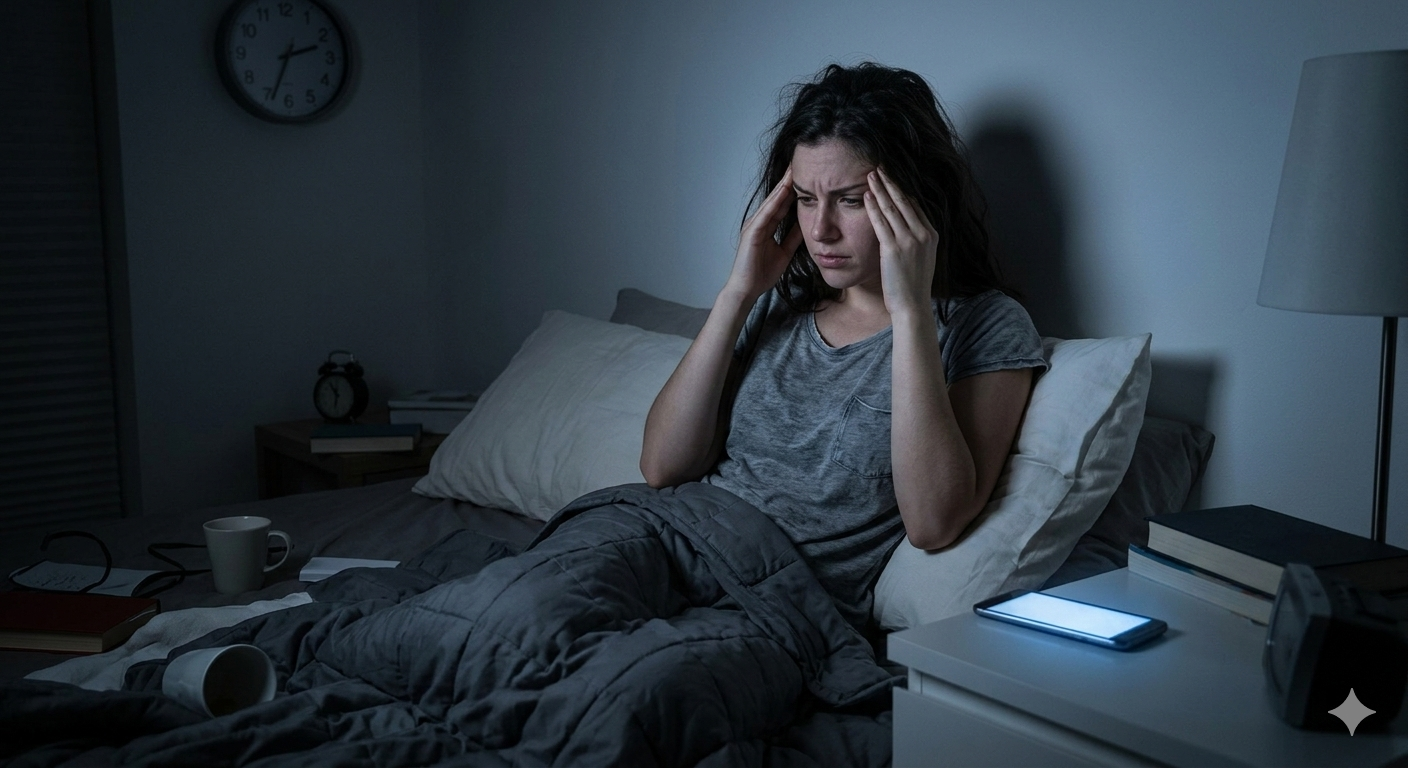
We’ve all been there. You’ve had a long, demanding day. Your body is heavy, your eyes are stinging, and all you want is the sweet relief of your pillow. But the moment your head hits the fabric, something shifts. Suddenly, you’re wide awake. The room is silent, yet your mind is screaming. You check the clock: 2:00 AM. Then 3:15 AM. You reckon exactly how many hours of sleep you’ll get if you fall asleep right now, only for that math to keep you awake even longer.
This universal frustration isn’t just “bad luck.” It’s a psychological disconnect between our ancient biology and our modern environment.
The Uninvited Guest: Meet “The Night-Watchman”
Imagine there is a version of you, let’s call him/her The Night-Watchman, who lives in a small corner of your brain. His only job for the last 200,000 years has been to keep you alive. In the wild, if the sun went down and you felt a “threat,” the Night-Watchman would dump a bucket of adrenaline into your system to make sure you didn’t become a snack for a predator.
The problem is that in 2026, the Night-Watchman can’t tell the difference between a sabertooth tiger and a blue-light-emitting smartphone.
Every time you “just scroll one more reel” or check your emails at 11:00 PM, you’re tapping the Watchman on the shoulder and whispering, “Hey, stay alert. There’s trouble.” You are consciously inflicting a state of “Hyperarousal” on yourself. You aren’t just “not sleeping”; you are actively training your brain to stay on guard.
Daily Solutions for Biological Durability
To quiet the Night-Watchman, we have to use biology, not just willpower. Here are the data-driven procedures to reclaim your rest:
- View Morning Sunlight (The Anchor): Your internal clock (Circadian Rhythm) starts its countdown the moment light hits your retina in the morning. Getting 10-15 minutes of direct sunlight before 10:00 AM anchors your cortisol spike and sets the stage for melatonin production 16 hours later. Here is the Role of Light in the human circadian rhythm.
- The 3-2-1 Rule ( The Buffer): To stop “The Night-Watchman” from panicking, create a buffer zone.
- 3 hours before bed: Stop eating (to avoid metabolic heat).
- 2 hours before bed: Stop working (to wind down your heart).
- 1 hour before bed: No screen (to stop blue light from suppressing melatonin). Learn more about the effects of blue light on sleep quality from Harvard Health Publishing.
Temperature Regulation (The Trigger): Your core body temperature must drop by 1°C to 2°C to initiate deep sleep. This is why a cool room (around 18°C) is superior to a warm one. A warm bath before bed actually helps because the rapid cooling afterward signals to the brain that it’s time to shut down. More on body temperature and sleep regulation here.
- Magnesium Supplementation (The Relaxant): Magnesium helps regulate neurotransmitters that quiet the nervous system. Specifically, Magnesium Bisglycinate is known for its ability to cross the blood-brain barrier and induce a state of calm. Here are the effects of magnesium supplementation on primary insomnia.
“Sleep is the price we pay for the privilege of a conscious life.” – Quote inspired by various neuroscientists.
Rest is not a luxury you earn; it is a biological requirement you respect. By implementing these solutions tonight – dimming the lights, setting down the phone, and cooling your environment, you aren’t just “going to bed.” You are reclaiming your metabolic integrity.
When you align your habits with your biology, sleep stops being a battle and starts being a superpower. You will wake up with a level of clarity and durability that makes your previous “best” feel like a distant memory.
More on The Daily Recovery: The UPF Effect: How Ultra-Processed Foods Are Rewiring Human Biology